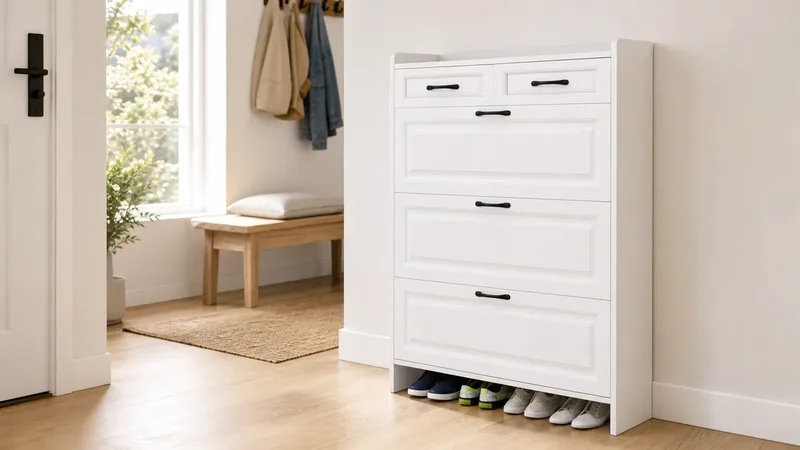
The White Ribbed-Front Shoe Cabinet with Drawers and Bottom Shoe Shelf is a useful direction for buyers who need a tall, narrow entryway storage SKU without relying on a plain flat-front cabinet. It combines a white textured front, two smaller upper drawers, three larger horizontal storage fronts, and an open lower shelf for frequently used shoes.
For furniture buyers, the value is not only the white finish. The product gives a clear entryway story for apartment programs, retail ranges, ecommerce listings, and mixed cabinet furniture orders. It belongs to the shoe cabinets category, where depth, opening layout, packing route, and usable capacity often matter more than decorative styling alone.
Why the ribbed white front changes the range position
A white cabinet is easy to place in many interior directions, but a flat white panel can look generic when it is placed beside mirrors, benches, hallway hooks, or light-wood furniture. This product uses a white ribbed or ray-texture front direction to create more surface definition while retaining an approachable, neutral color.
That gives retailers and online sellers a more descriptive product story: a textured white entryway cabinet with upper drawer utility and an open lower shoe shelf. It can sit within a value-to-mid-range hallway assortment without requiring an elaborate material route or a highly decorative finish.
Size direction for narrow hallways and apartment entrances
The current product record lists widths from 50 to 100 cm, depth options of 17 cm and 24 cm, and a reference height of 127 cm. Those dimensions should be treated as a sourcing direction rather than a final production commitment, but they are useful when a buyer needs a tall cabinet that makes use of vertical wall space while limiting hallway projection.
Depth is the first practical filter. A 17 cm route can suit very narrow entrance areas when the storage structure and target shoe size are appropriate. A 24 cm route may give more workable internal space, but it also changes carton planning and placement. Buyers should confirm the intended shoe capacity, wall clearance, opening method, and anti-tip requirement before approving a final specification.
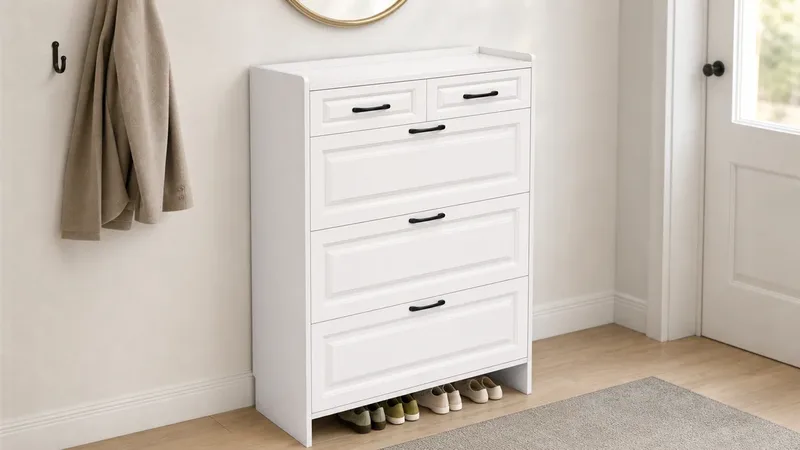
Drawer layout and lower-shelf use
The two smaller upper drawers create a separate place for everyday entryway items such as keys, shoe-care accessories, spare laces, or small household items. The larger horizontal storage fronts make up the main cabinet body, while the lower open shelf keeps the most frequently used shoes accessible.
For an RFQ, the buyer should not assume internal shelf layout from the exterior image alone. Confirm the internal shoe angle, shelf spacing, hardware route, door or drawer opening structure, and whether adult shoes, boots, or mixed household footwear are the target use. These details affect both buyer satisfaction and the correct packing configuration.
Best-fit buyer channels
For apartment and rental programs, this cabinet can work where the buyer wants an entrance storage piece with a taller vertical profile and simple neutral finish. The textured white front adds enough visual detail for furnished-unit photos while the narrow depth direction helps protect corridor space.
For retail collections, it can be grouped with light-wood benches, hallway mirrors, coat hooks, and other white storage pieces. For ecommerce, the product needs a clear image sequence: a front view, a depth view, close-ups of the texture and handles, the lower shelf, the storage opening, and the flat-pack or carton route. Those images should be reviewed before launch rather than generated from a single cover image.
How it differs from other shoe cabinet routes
Buyers looking for a more compact two-door body with drawer utility can compare this direction with the White PVC-Finished Two-Door Shoe Cabinet with Double Drawers. That product is a different cabinet structure and should be quoted separately instead of being treated as a finish variation.
If the primary requirement is a slim flip-front entryway item with warm oak contrast, the Nordic Two-Tone Flip Door Shoe Cabinet is a relevant comparison. Its buyer story is more Nordic two-tone and compact-hallway focused, while this white ribbed cabinet is stronger where a taller all-white cabinet, upper drawer utility, and an open lower shelf are the priority.
The narrow shoe cabinet and shoe cabinets with drawers pages provide additional product directions, but the final selection should always be made against the buyer's depth limit, required capacity, price level, and packaging needs.
Packaging and quality points to confirm
As panel furniture, the product route should be quoted with export carton packaging, inner protection, labels, and loading plan confirmed by RFQ. White surfaces and textured fronts need protection against edge damage, rubbing, and visible marks. The upper drawers, larger storage fronts, black handles, and lower open shelf should be checked for panel alignment, gap consistency, screw-pack accuracy, handle position, and stability after assembly.
For ecommerce or multi-warehouse distribution, ask about carton drop protection, corner guards, hardware bag placement, instruction sheet clarity, barcode position, and whether the carton can be handled by the destination team. The cabinet furniture packaging and QC guide gives a broader checklist for these points.
Using this shoe cabinet in a wider buying list
A buyer does not need to source one full container of this cabinet alone. It can be considered with coffee tables, TV cabinets, sideboards, drawer chests, and other cabinet furniture when the buyer is building a broader home storage range. Furniture Sourcing Plus can coordinate the product route, quotation follow-up, packaging review, and mixed-loading discussion through one contact.
To request a practical quotation, send the required width and depth, target market, estimated quantity, preferred texture or finish reference, packaging requirement, and whether the cabinet is part of a wider order. The mixed-SKU carton planning guide explains the carton and loading data needed before several furniture categories are combined. Buyers can start from this product page or send the complete list through the inquiry form.