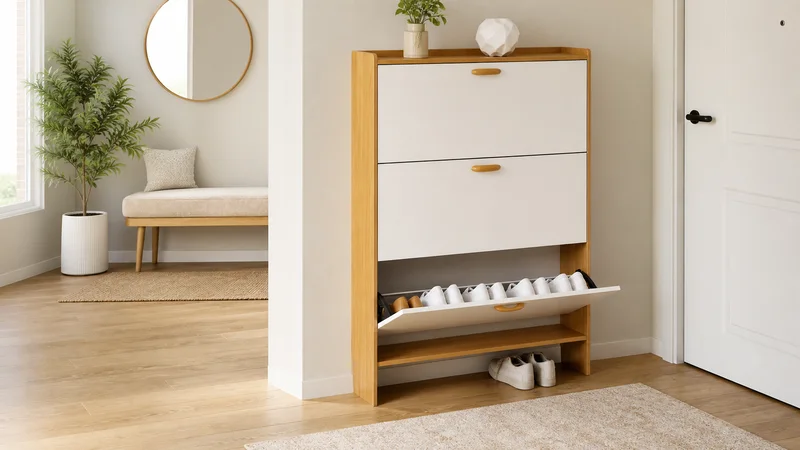
The Oak and White Three-Flip Shoe Cabinet with Open Shoe Shelf gives buyers a clear entryway-storage direction: keep a slim wall profile, separate closed flip storage from a visible lower shelf, and use a warm oak-and-white finish that can sit beside light flooring and neutral hallway furniture. The current product record lists widths from 50 to 100 cm, 17 cm and 24 cm depth options, and a reference height of 115 cm.
This is not simply a white shoe cabinet with a different trim color. Its three flip-front compartments, open bottom shelf, and oak-framed visual story make it a useful route for apartment programs, retail entryway ranges, ecommerce listings, and mixed cabinet-furniture orders. It belongs to the shoe cabinets category, but should be specified against the buyer's daily-use pattern and corridor depth rather than selected from a front image alone.
Closed storage and an open lower shelf solve different entryway tasks
The three flip fronts are intended to keep part of the shoe-storage area visually closed, while the lower shelf gives an accessible space for frequently used footwear. That creates a more practical arrival-and-departure rhythm than an entirely closed cabinet. For a retail display or ecommerce listing, it also gives buyers two different visual cues: a tidy closed-front furniture piece and an obvious lower access zone.
The reference exterior does not establish exact pair capacity, shoe angle, internal divider count, or whether particular boot heights will fit. Those points must be confirmed by RFQ with the final depth route and the target user's footwear. The open shelf should likewise be evaluated as an access feature, not quoted with an assumed capacity.
Use depth and width as range-planning controls
The 17 cm and 24 cm depth directions are useful when hallway projection matters. A 17 cm version may suit a more constrained installation, while a 24 cm route can offer a different practical balance. Neither option should be selected without checking door swing, skirting boards, usable passage width, wall clearance, and the intended shoe-storage mechanism.
The available width direction from 50 to 100 cm lets buyers use one finish and structure story across smaller apartments and wider entry walls. The 115 cm reference height creates a vertical storage profile while leaving the lower shelf close to floor level. Final external dimensions, internal layout, assembly requirements, and carton size should be confirmed for the selected width before sample approval.
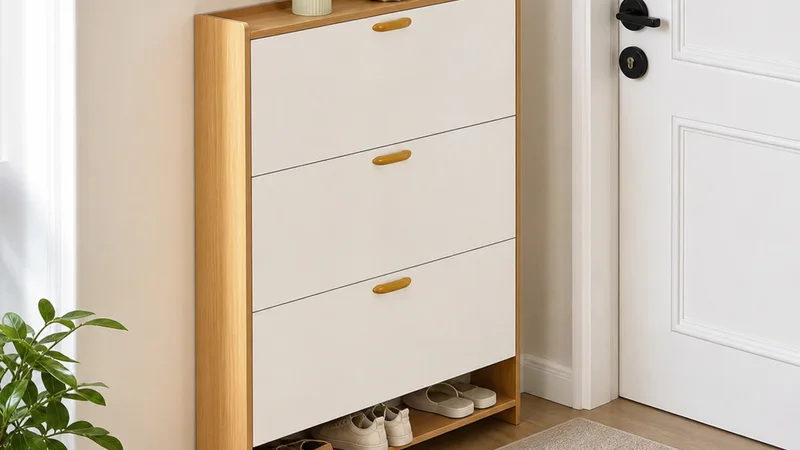
Why the oak-and-white finish has a distinct retail position
A white front helps the cabinet sit comfortably in compact, light-toned interiors, while the oak side frame and pulls add warmth without creating a heavy dark cabinet direction. Buyers can use the product in Nordic, apartment, or practical family-entryway collections, but the final finish still needs a controlled sample. Confirm the oak tone, grain direction, white-panel sheen, edge banding, handle color, and how the finish reads across the side panels, top ledge, and open shelf.
The product record defines a panel-furniture route confirmed by RFQ. It does not fix a board grade, hinge or flip hardware brand, or coating specification. Those details should be put into the enquiry together with the required target-market documentation, so the product remains repeatable if the buyer expands from one width to a full entryway range.
Sample and packaging checks that matter
For a working sample, check the three flip fronts for alignment, smooth movement, safe hand clearance, consistent gaps, and secure closing. Inspect the open shelf for panel alignment and stability. Confirm wall-fixing or anti-tip expectations, handle attachment, fastener positions, exposed edge treatment, and assembled stability on a level floor. These checks are more useful than approving a cabinet solely from a styled image.
The current record gives a 30 to 45 day lead-time direction after order details and sample confirmation, while MOQ, final packaging, material route, and loading plan remain RFQ items. For export cartons, confirm panel separation, corner protection, hardware-bag placement, instruction clarity, barcode location, and how the open shelf and flip hardware are protected. The cabinet furniture packaging and QC guide provides the broader export checklist.
How it differs from other slim shoe cabinet routes
The Handleless White Three-Flip Shoe Cabinet is a cleaner all-white, handleless direction with its own size and front design. The Slim Grey Four-Door Shoe Cabinet uses a wider multi-door grey route. Both should be quoted separately rather than treated as simple finish variations of this oak-and-white open-shelf design.
Buyers seeking a deeper, more substantial cabinet body can compare the Vintage Black Two-Door Shoe Cabinet, which follows a listed 34 cm depth route. The narrow shoe cabinet collection can help start a comparison, but final selection should follow the approved depth, opening method, lower-shelf requirement, finish reference, and packaging plan.
Include it in a wider one-stop furniture order
A buyer can use this entryway cabinet as one part of a broader home range rather than filling a container with a single item. It can be reviewed together with coffee tables, TV stands, sideboards, drawer chests, and other cabinet furniture. Furniture Sourcing Plus can coordinate product references, RFQ follow-up, packaging checks, and mixed-loading discussion through one sourcing contact.
For a practical enquiry, send the preferred depth and width, target market, finish reference, opening preference, packaging standard, quantity plan, and wider buying list. The mixed-SKU furniture container planning guide explains which carton data should be collected before categories are combined. Buyers can start from this product page or send the full requirement through the inquiry form.