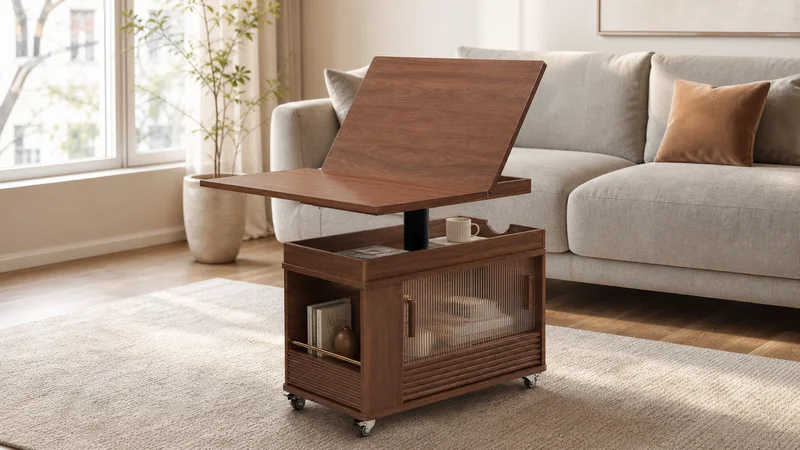
The Folding Lift Top Coffee Table is a useful sourcing direction when a buyer needs more than one tabletop condition from a compact living-room cabinet. The reference product combines a fold-out surface, a separately raised tabletop direction, a warm walnut presentation, a fluted translucent-front storage area, an open side section, and a caster base. The current product record lists an expanded desktop of 73 x 80 cm and a height direction from 61 cm to 84.5 cm.
That combination should be evaluated as a moving-part furniture SKU, not simply as a fixed coffee table. Buyers need to confirm each intended tabletop position, the selected finish, the approved mechanism, and the carton plan before adding it to an apartment, retail, ecommerce, or mixed-container range. It sits within the coffee tables and side tables category, but its sourcing work begins with function verification.
Plan the two tabletop states before writing the product story
The reference image shows a fold-out horizontal surface together with a walnut panel raised on a central support. This creates a stronger worktop and display story than a fixed low table, but a photo alone does not establish the approved operating sequence, hardware specification, locking method, load rating, or safe use limits. Those must be supplied by the confirmed factory route and sample.
For a buyer, the practical question is not whether the table can be called multifunctional. It is what the selected configuration will do in a real room. Define the use cases first: a low coffee-table position, a temporary laptop or snack surface, a wider display area, or a combination of these. Then request images and drawings for every approved state so a retail buyer or ecommerce customer does not receive an ambiguous product listing.
Use the recorded dimensions as a starting point, not a complete specification
The current product record gives a 73 x 80 cm expanded desktop and a 61 cm to 84.5 cm height direction. These figures help buyers decide whether the product belongs in an apartment, sofa-side, or more flexible living-room program. They do not replace a dimensioned drawing. The final RFQ should state the tabletop size in each position, overall body size, wheel clearance, edge profile, open clearance, and the measurement reference used for the height range.
When the product is sold online, the same approved dimensions must appear on the product page, image diagram, carton label, assembly material, and quotation. This prevents a common problem with transformable furniture: showing one attractive open position while the commercial documents describe a different size or mechanism.
Keep the visible storage elements tied to the approved version
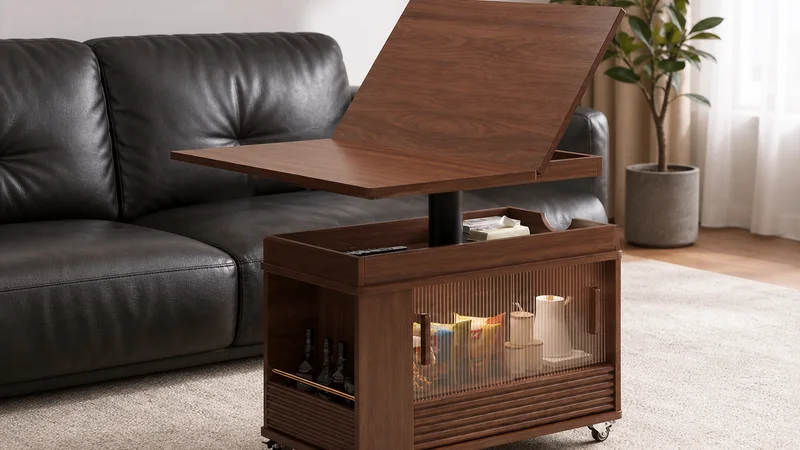
The reference direction shows a cabinet-style walnut body, a vertically fluted translucent front door with a slim pull, an open side storage space, and a caster base. Those details give the item a warmer, more furniture-led visual than a plain lift table. The internal shelf layout, door material, glass or acrylic specification, hardware brand, soft-close requirement, and wheel-locking requirement are not fixed in the public record. They should be confirmed before the buyer promises a storage capacity or mechanism feature.
The current material route is eco-board panel with a melamine finish. Available finish references include White, White + Walnut, and Walnut. The lifestyle images in this article use the walnut direction to keep the product structure clear; they are not a substitute for an approved physical finish sample. A buyer who needs a matched range should request the final panel reference, edge-band treatment, handle finish, and finish-consistency check together.
Sample the motion, stability, and daily-use details
A sample review should cover more than finish and front appearance. Ask the factory to demonstrate the fold-out movement, raised tabletop movement, transition between positions, panel alignment, handle placement, cabinet-door action, caster movement, and any brake or lock requirement. Check for pinch points, exposed fasteners, edge treatment, uneven gaps, and whether the table remains stable in each approved condition. Any load or safety statement should come from the approved specification, not from an assumption based on the reference image.
For buyer-facing content, request a complete image pack: folded overview, each approved open position, side view, rear view, close-up of moving hardware, storage view, dimensioned drawing, packaging view, and finish samples. This material is more useful than repeating generic multifunction claims because it helps importers, retailers, and ecommerce teams describe the real product they intend to sell.
Compare the product by operating layout, not only by finish
The Fold-Out Coffee Table with Wide Top is a relevant comparison for buyers who prioritize a broader tabletop route, but it should be quoted as its own layout. The Two-Tone Expandable Coffee Table follows a different mobile cabinet and expanded-surface direction. For a smaller sofa-side storage option, review the Compact Storage Side Table Cabinet. These are distinct products; their mechanisms, displayed dimensions, storage layouts, and cartons should not be combined into one specification.
Buyers can also read the two-tone expandable coffee table guide for another open-versus-closed planning route. That article is useful for range comparison, while this product is focused on a folding and raised-tabletop arrangement that needs its own sample checks.
Confirm packing before combining the order
The current record lists a reference carton size of 83 x 49 x 71 cm and an approximate packed weight of 36 kg. These figures should be rechecked against the final approved finish and hardware configuration before booking freight. For moving furniture, confirm corner protection, panel separation, door and tabletop restraint, hardware bags, wheel protection, carton markings, and drop-test or handling expectations where required by the target market.
The cabinet furniture packaging and QC guide provides the broader inspection sequence. This table can be sourced together with TV units, drawer chests, sideboards, and shoe cabinets when buyers want a wider furniture program. The mixed-SKU container planning guide explains why each SKU needs confirmed carton data before a one-stop order is loaded.
Send an RFQ that can be quoted accurately
Send the target market, required tabletop positions, selected finish, quantity plan, requested hardware and wheel requirements, packaging standard, and any other furniture categories to combine. Furniture Sourcing Plus can coordinate product references, sample questions, packaging checks, and mixed-loading follow-up through one sourcing contact. Begin from this product page or send the buying brief through the inquiry form.