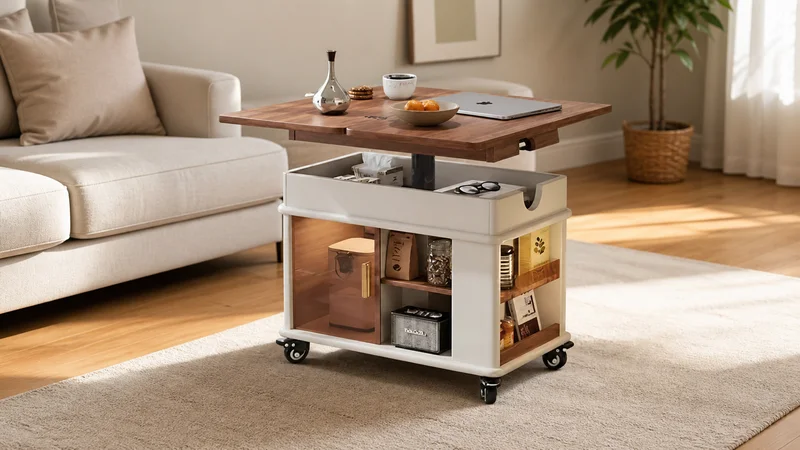
The Two-Tone Expandable Coffee Table is useful when a buyer wants one living-room item to be planned in two practical states: a compact footprint for normal circulation and a wider surface when more tabletop area is needed. The current product record gives a 70 cm length, a width direction from 40 cm to 80 cm, and a 73 cm height. Its white-and-walnut or black-and-walnut directions, mobile cabinet body, glass-door detail, open storage, and caster base make it more than a simple fixed coffee table.
This article focuses on closed-to-open range planning. That is different from a generic lift-top story: the buyer needs to understand how the table occupies the room in both positions, how the expanding surface moves, what is protected during shipment, and whether the finish and storage layout remain consistent across the selected color route.
Start with the two footprint states
The stated product size direction is 70 x (40-80) x 73 cm. In practical terms, the buyer should treat 40 cm and 80 cm as two planning states, not as a single headline dimension. The compact state affects sofa clearance, aisle space, and apartment placement. The expanded state affects the usable surface and the space needed around the table while it is open.
Before approving a sample, request a dimension drawing that shows both positions, tabletop travel, overhang, the user-side opening direction, and the clearance needed beside sofas or other furniture. Confirm whether the tabletop locks or rests securely in each state, how it aligns when returned to compact form, and whether any hand-clearance risk exists during use. These questions should be answered by the actual mechanism, not by a styled image.
What the reference product visibly combines
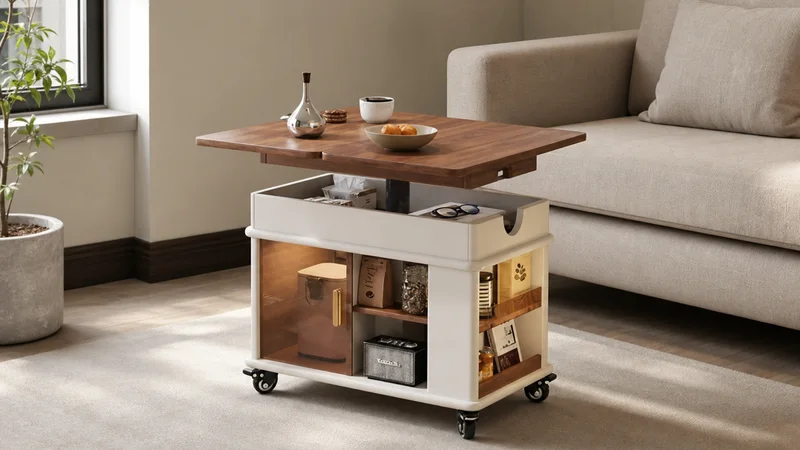
The supplied reference shows a white mobile cabinet body with a walnut tabletop, an upper open tray, a smoked-glass cabinet door with a brass-tone vertical pull, open central and side storage, and four small casters. The visual also shows a tabletop that can be used in a wider configuration. These visible elements should be held in the sample brief so the final product does not lose the storage-and-mobility story that differentiates it from a basic panel coffee table.
The reference does not establish a fixed shelf count, load rating, caster-lock specification, glass grade, or mechanism type. Those points need RFQ confirmation. A buyer should also confirm whether the table ships assembled, partly assembled, or flat packed, because the moving top, glass door, and caster base all affect packing and destination assembly work.
Use finish routes as controlled variations
The current record lists White + Walnut and Black + Walnut finish directions. These can support different retail stories: white plus walnut can sit in lighter apartment or Scandinavian-oriented collections, while black plus walnut can create a higher-contrast living-room direction. The final finish needs more than a color name. Request samples for the tabletop, cabinet panels, glass-door frame, open-shelf panels, visible edges, and any painted areas.
The material route is listed as solid wood eco-board panel with painted and melamine finish directions. Buyers should write the final panel construction, finish standard, grain or tone reference, sheen, edge treatment, and visible hardware color into the RFQ. Those decisions affect both product appearance and the repeatability of a two-tone assortment across later orders.
Mobility and storage checks before sampling
The caster base makes movement part of the product experience. Confirm wheel material, rolling behavior on the intended floor type, whether locking is needed, the wheel mounting method, and how casters are protected in the carton. Check stability in both tabletop positions on a level floor. The open storage areas and glass-door cabinet should be reviewed for panel alignment, door action, safe edges, and practical access rather than assumed from the reference image.
For ecommerce photography, buyers should request a compact-state view, expanded-state view, side view, caster close-up, glass-door detail, open storage view, product dimensions, and carton or assembly reference. This gives customers a clear reason for the expandable structure and reduces the risk that the item is presented as a standard fixed table.
Packing data and export preparation
The current record gives a reference packing size of 83 x 49 x 71 cm and an approximate packed weight of 36 kg. These numbers are useful for early mixed-container planning, but final carton dimensions and gross weight must be confirmed after the selected finish, glass protection, caster route, and shipping state are fixed. A changing tabletop mechanism or extra protection can materially affect the loading plan.
For export review, confirm tabletop immobilization, glass protection, corner guards, hardware-bag position, instruction content, barcode location, and carton-handling requirements. The cabinet furniture packaging and QC guide provides the wider checks for panel furniture, glass details, and moving components.
How it differs from other flexible coffee table routes
The Compact Expandable Coffee Table is a separate structure for buyers who need a different small-space direction. The Folding Lift Top Coffee Table should also be quoted separately because its height and tabletop movement route are different. The Multi-Color Lift Top Coffee Table is useful for a broader finish-range comparison, not as a substitute for this mobile two-tone cabinet structure.
The expandable coffee table collection can help buyers compare directions, but each product needs its own approved size state, mechanism, storage layout, material route, and packaging plan.
Include it in a wider one-stop buying list
A buyer can include this table in an apartment, ecommerce, or retail assortment alongside shoe cabinets, TV stands, sideboards, and other cabinet furniture. Furniture Sourcing Plus can coordinate product references, RFQ follow-up, finish checks, packing discussion, and mixed-loading planning through one sourcing contact.
For a practical RFQ, send the preferred finish direction, target market, quantity plan, required compact and expanded use case, packaging standard, and wider buying list. The mixed-SKU furniture container planning guide explains which carton data should be collected before categories are combined. Buyers can start from this product page or send the complete requirement through the inquiry form.