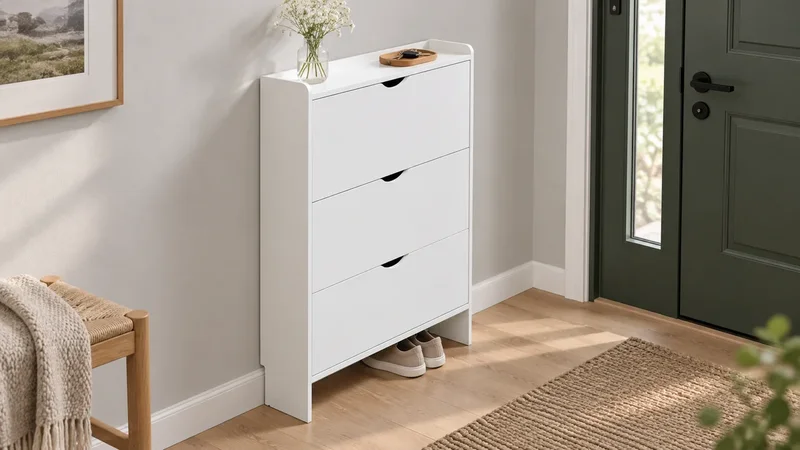
A hallway cabinet should provide useful storage without becoming the first bulky object someone meets at the door. The Handleless White Three-Flip Shoe Cabinet takes a restrained approach: three plain white fronts, recessed finger pulls rather than projecting handles, and a shallow cabinet body. For furniture retailers, ecommerce sellers and apartment furnishing buyers, it is an option worth considering when a simple, compact entryway piece is missing from the range.
This feature focuses on Product No. FSP-SC-SCN-Q2507-04. The product record lists six widths, two depth options and a height of 118 cm. The appeal is not a complicated mechanism or an unverified capacity claim. It is the combination of a clean front, several size choices and a storage format that can be considered alongside other furniture in one sourcing plan.
What makes the handleless design different?
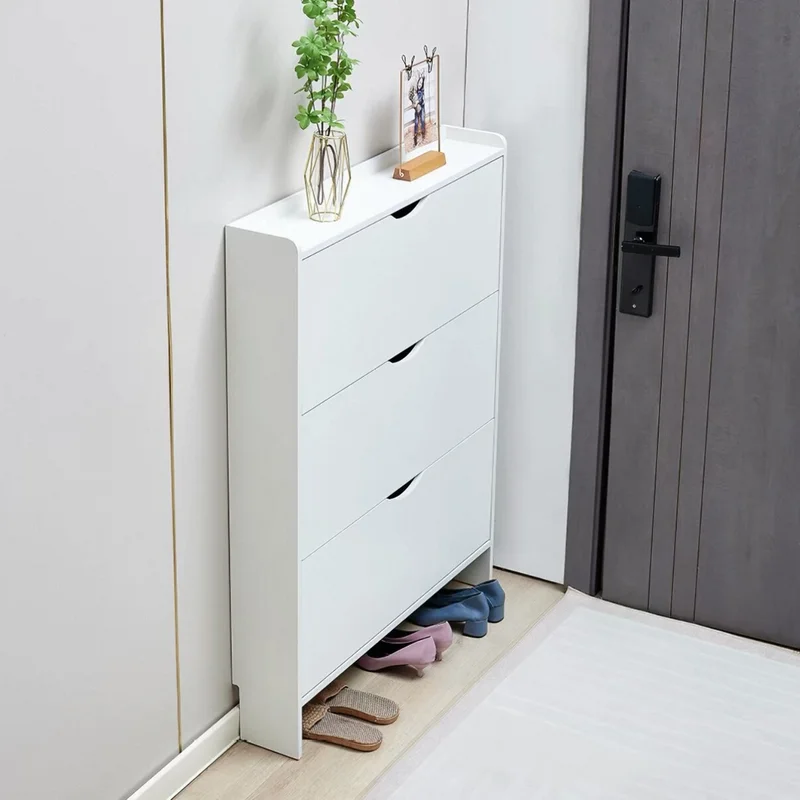
The reference image shows a curved finger recess at the top of each of the three flip fronts. These openings provide a visible place to grip without adding a knob or bar handle to the cabinet face. Here, handleless means recessed access; it does not mean that a push-to-open system is included. The smooth panels also avoid the decorative mouldings and contrasting hardware found on more traditional hallway cabinets.
The white finish can sit quietly against a pale wall or contrast with a darker entrance door. A narrow top surface provides a place to style a small tray, while the side panels continue down to the floor and leave an open gap beneath the lowest front. That gap is visible in the product reference, but its usable height should be measured on the selected version before promising space for any particular shoes. It is not a separate enclosed drawer.
Choose depth before choosing width
For a small hallway, the available wall length is only half the story. Measure the passage, door swing, skirting and any nearby cupboard before choosing a cabinet. The listed 17 cm and 24 cm depths differ by 7 cm, which can matter in a tight entrance. Neither figure describes the space needed with a flip front open: operating clearance needs to be checked separately on a drawing or sample.
- Listed widths: 50, 60, 70, 80, 90 and 100 cm.
- Listed depths: 17 or 24 cm.
- Listed height: 118 cm.
- Storage layout: three flip-front compartments with recessed finger pulls.
- Material: panel furniture; the substrate and finish specification require quotation confirmation.
These are the current sourcing options, not a statement that every combination is in stock. Start with the space constraint, then ask for a drawing of the exact width-and-depth combination. For a retailer testing a new range, selecting a compact width and a wider alternative may be more useful than launching every listed size at once. The order mix and minimum quantities still need to be agreed.
A specific role in an entryway assortment
This cabinet is most relevant when buyers want visually simple shoe storage rather than a prominent decorative piece. In an apartment furnishing package, it can serve as the entrance component while living-room tables and other storage pieces are selected separately. For ecommerce, the recessed pulls and shallow profile are details worth showing clearly in product photography, alongside an accurate dimension drawing.
Different storage needs call for different products. Buyers who want separate upper drawers can compare the Modern Grey Two-Door Shoe Cabinet with Drawers. Buyers seeking a light front with timber-colour accents can review the Nordic Two-Tone Flip Door Shoe Cabinet. These are separate designs, not finish variants of this handleless model. Our white two-door cabinet guide explores the door-and-drawer alternative in more detail.
Check the interior before making capacity claims
An exterior photograph cannot establish how many pairs will fit. Shoe length, heel height, internal dividers and the selected cabinet depth all affect usable storage. Request an open-front photograph or short demonstration of the exact version, then test it with the footwear types your customers actually use. Do not assume that boots, high heels and larger trainers fit equally well.
The sample review should also cover comfortable access to each finger recess, consistent gaps between fronts, smooth operation and the interior layout. Ask for the installation instructions and the supplier's wall-fixing requirements; do not market the cabinet as safe to use without anchoring unless that has been verified. The current record does not establish soft-close hardware, waterproof construction or a tested load rating, so none of those should be added to a listing without evidence.
Turn the reference into a clear retail specification
White furniture needs a precise finish reference: two products described simply as white can differ in tone and sheen. Confirm the panel substrate, edge treatment, surface finish, cleaning instructions and hardware on the approved sample. A useful selling image set would show the full closed cabinet, the finger recesses, an approved open-compartment view and a dimension drawing. The styled scene above illustrates a possible setting; it does not document a completed customer installation or unseen internal features.
Before bulk packing is approved, review protection for the panel edges, top corners and recessed pull areas, together with hardware bags and assembly instructions. The cabinet packaging and QC checklist provides a practical starting point. Final carton dimensions and gross weight are not supplied in the current record and should be obtained for the confirmed construction and packing method.
One hallway product, one wider furniture buying list
You do not need to plan a full container of this shoe cabinet alone. Furniture Sourcing Plus can review it together with coffee tables and side tables, TV cabinets, sideboards and other furniture requirements. If a needed item is not in the public catalogue, send its reference and specification so we can look for suitable supply options.
The aim is to coordinate different categories through one sourcing contact and build a workable mixed shipment. Consolidation can help use container space more effectively, but savings depend on carton volume, order quantities, collection costs, loading compatibility and production schedules. Our mixed-SKU container planning guide explains what information is needed before a loading plan can be agreed.
To discuss this cabinet, send Product No. FSP-SC-SCN-Q2507-04, your preferred width and depth, target market, quantity and delivery schedule, together with the rest of your furniture list. Send your buying brief for specification checks, sample planning and a combined sourcing discussion.