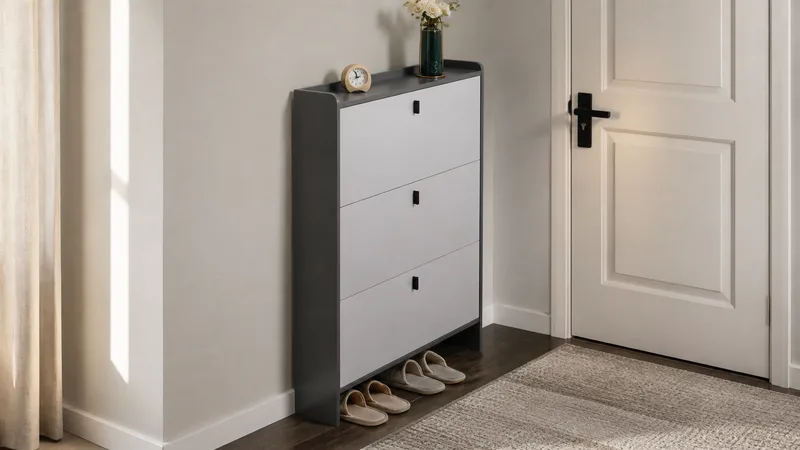
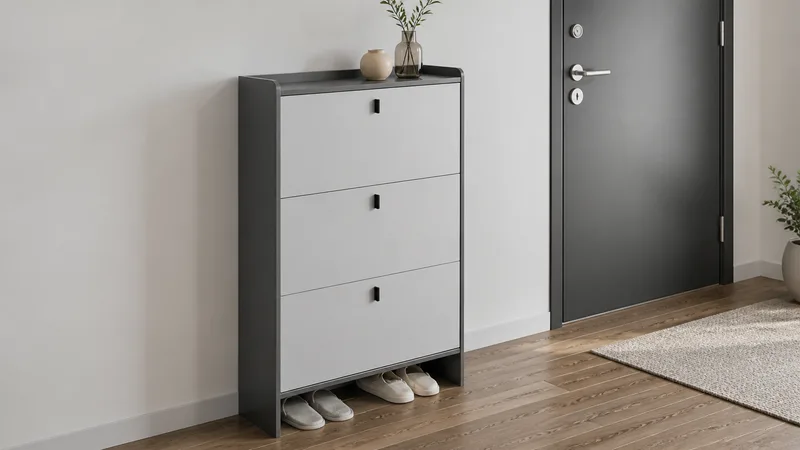
The Slim Grey Two-Tone Three-Flip Shoe Cabinet is a practical direction for buyers building a compact entryway range around shallow cabinet projection. The current product record lists an 118 cm height, 17 cm and 24 cm depth directions, and widths from 50 to 100 cm. Its visible route combines a dark-grey cabinet frame and recessed top edge with three light-grey flip-front panels, three small black pulls, and open shoe space at the base.
That specification makes it different from a deep two-door cabinet. A narrow entryway buyer normally begins with circulation and door swing, then chooses the cabinet depth and width. In the shoe cabinets category, this product should be evaluated as a coordinated range option rather than sold on an assumed pair count or unconfirmed internal layout.
Start with the wall, the door, and the depth direction
The 17 cm and 24 cm depth directions are the main sourcing variables. A 17 cm body can suit very tight hallways where the clear walking route matters most. A 24 cm body provides a different internal-space direction but also projects further into the room. Neither number alone confirms usable shoe size, capacity, opening clearance, or whether a particular door can pass comfortably beside the cabinet. Request a scaled side view for the chosen size and check it against the actual entrance, skirting, door swing, and circulation path.
Widths from 50 to 100 cm let a buyer keep one grey two-tone visual direction across several wall positions. Each width still needs its own approved drawing, cut list, carton dimensions, and quotation. This is especially important for apartment projects and ecommerce programmes, where one product name may cover more than one sellable size but the final carton and internal configuration may not be the same.
Use the 118 cm height as a range-planning point
At 118 cm high, this three-flip route sits above a low shoe cabinet and below a full-height hallway storage programme. The top surface can create an arrival-zone styling opportunity for a small tray or decorative item, but it should not be described as load-bearing storage unless the selected panel specification and test requirement have been confirmed. For buyer catalogues, keep the top-surface claim modest and use the approved sample as the reference.
The visual combination of three aligned fronts, dark side panels, and small black pulls is useful where a buyer wants a neutral cabinet that can sit beside grey, black, white, or wood-accented furniture. Colour matching, gloss level, edge treatment, and pull finish should be approved by sample. A lifestyle scene helps show the intended setting; it does not replace a finish board or production reference.
Separate the visible structure from the RFQ details
The current public record confirms three flip-front storage compartments and compact depth options. It does not fix the internal divider count, shoe capacity, flip mechanism, soft-close requirement, hardware brand, board thickness, wall-fixing method, or load rating. Those details belong in the RFQ and sample review. Keeping that boundary clear avoids a common problem: an online listing promises an internal configuration that was only visible in a reference image.
Ask the supplier to provide front, side, rear, open, hardware, and dimension images for the selected size. The buyer should also confirm the opening sequence, exposed-edge treatment, handle position, wall-fixing parts, and assembly instructions. For a three-flip cabinet, these checks make the final product description more useful than broad claims such as “large capacity” or “universal fit.”
Build a controlled grey entryway assortment
The Slim Grey Four-Door Shoe Cabinet gives buyers a broader 80-120 cm width route and a 119 cm height direction. The Grey Two-Flip Shoe Cabinet with Drawer is a lower 95 cm cabinet route. These products share a neutral grey direction, but they should be sampled and quoted independently because their visible storage layouts, width ranges, dimensions, hardware needs, and cartons are different.
For a lighter visual alternative, the Handleless White Three-Flip Shoe Cabinet uses another three-flip route. Buyers can also browse the narrow shoe cabinet collection for initial comparison. The correct final choice is the one that matches the required depth, approved finish, packaging route, and target-market entryway dimensions.
Plan packing before combining cabinet categories
The product record gives a 30-45 day lead-time direction after order details and sample confirmation. MOQ, material route, final hardware, carton dimensions, packed weight, and loading plan remain RFQ items. During sample approval, inspect panel alignment, three-front consistency, handle placement, movement of each approved flip section, cabinet stability, exposed edges, hardware bags, wall-fixing parts, and instructions.
For export packing, confirm panel separation, corner protection, flip-front restraint, carton strength, labels, and handling marks against the final size. The cabinet furniture packaging and QC guide explains the wider review sequence. This shoe cabinet can also be quoted alongside coffee tables, TV stands, sideboards, and drawer chests through one buying list; use the mixed-SKU container planning guide to collect carton data before combining categories into one shipment.
Send a useful sourcing brief
For a practical quotation, send the target market, selected width and depth, finish reference, expected internal layout, wall-fixing requirement, quantity plan, packaging standard, and other furniture categories to combine. Furniture Sourcing Plus can coordinate product references, sample questions, packing checks, and mixed-loading discussion through one sourcing contact. Start from this product page or send the buying brief through the inquiry form.